
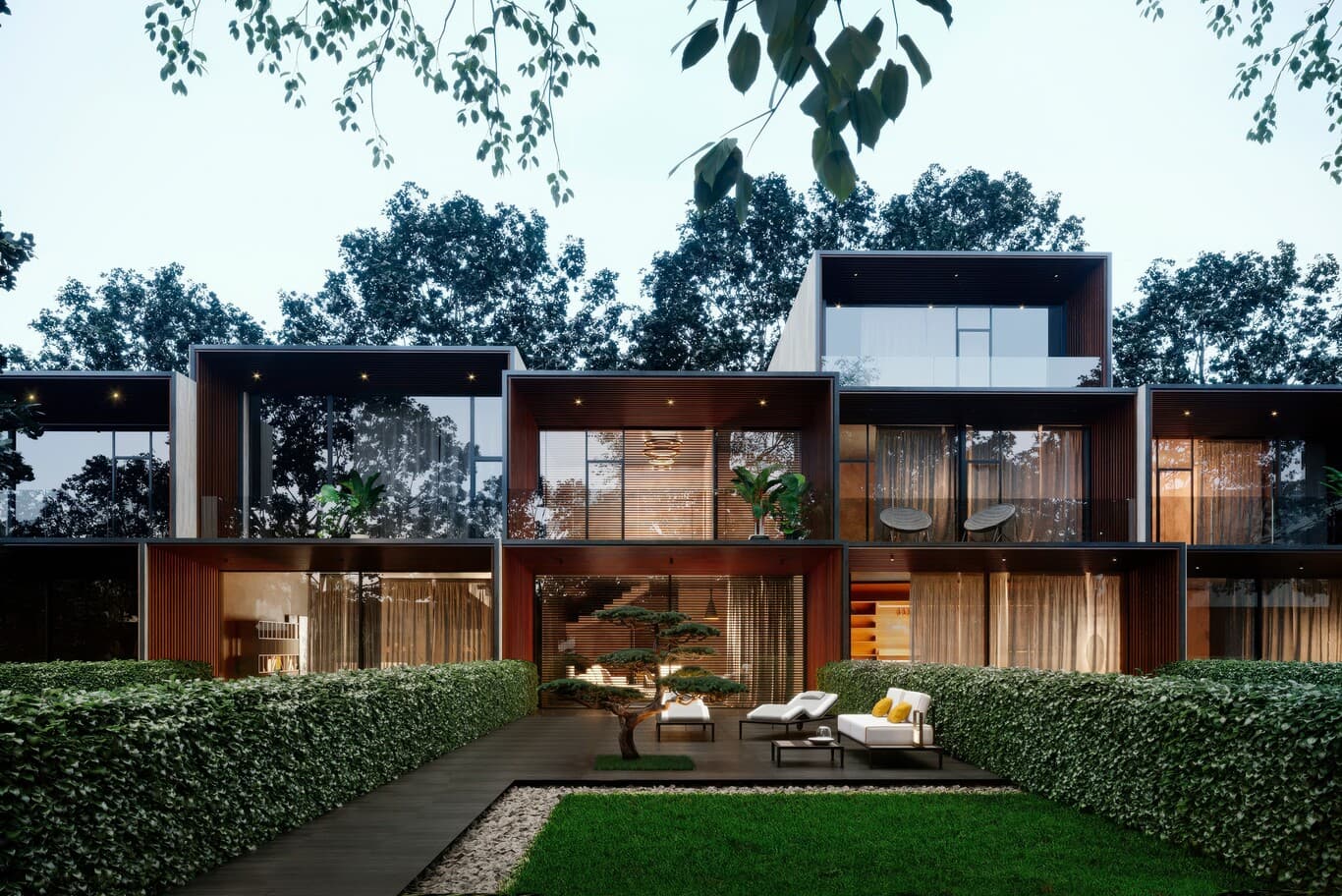
Smart home systems need construction-phase planning. Here is how we handle automation wiring and integration on Dubai villa builds.
We get calls every few months from villa owners who finished their build six to twelve months ago and now want a KNX or Crestron system installed. The conversation always reaches the same point: the automation integrator needs cable pathways that do not exist, control wiring behind walls that are plastered and painted, and a dedicated equipment closet that was never planned into the layout. Retrofitting that infrastructure through finished surfaces runs two to three times the cost of running it during the rough-in phase, and the result is never as clean.
Smart home integration is a construction scope item. It has cabling, conduit, structural blocking, and equipment room requirements that need to be on the shop drawings alongside your HVAC, electrical, and plumbing runs. Across the luxury villa projects we deliver in Dubai, automation infrastructure is treated no differently from any other building service — it goes on the drawings, into the programme, and through the coordination process. Treating it as a separate purchase after handover is how villa owners end up with exposed cable trays, surface-mounted conduit, and systems that work around the building rather than within it.
Smart Home Infrastructure Requirements
A functioning automation system depends on physical infrastructure that sits inside wall cavities, ceiling voids, and floor slabs. Structured cabling — Cat6A or fibre — needs to reach every room from a central distribution point. Motorised blind and curtain motors need dedicated power circuits at window head height. Dimmable lighting requires specific driver types and control wiring back to the automation processor. In-ceiling speakers need back boxes and cable runs. Security cameras, intercoms, and access control panels all need data and power at their mounting locations.
The rough-in phase of construction is the only practical window to install this backbone. Once gypsum boards are fixed, ceilings are closed, and paint is applied, every cable run means cutting open finished surfaces, routing around obstacles, patching, and repainting.
On our Tilal Al Ghaf luxury residential fit-out — a 4,200 sq ft villa in one of Dubai's master-planned communities — the automation scope covered lighting, climate control, security, and an integrated entertainment system. We ran all structured cabling during the interior fit-out while walls and ceilings were still open for MEP first-fix. The client's integrator provided wiring schedules that our electricians followed alongside the standard electrical installation. Custom millwork concealed all control processors and network hardware behind flush access panels — nothing visible in the living spaces. Kitchen and bathroom smart fixtures connected to the central system through pre-planned routes, not retrofitted ones. Every cable was in place before the first coat of plaster went on, and the system commissioned without a single surface being reopened.
On a recent Dubai Hills villa, our team integrated the automation cabling layout into the electrical shop drawings during the MEP design stage. Conduit routes were coordinated with HVAC ductwork and plumbing, and every switch and sensor location was confirmed against the integrator's control plan before the first cable was pulled. That is what a proper construction management company looks like when automation is part of the scope.
Three Decisions That Cannot Wait Until Fit-Out
The recurring problem we see on villa projects is the automation integrator being brought in after the MEP consultant has already finalised the electrical design. By then, the distribution board layout, circuit counts, and switch plate locations are set for a standard build, and redesigning them for automation means change orders and programme delays. Anyone familiar with the full villa construction process from design through handover will recognise that the MEP design window is narrow — once it closes, changes carry a cost.
These three items need to be confirmed before your villa enters detailed design.
Control platform. KNX, Crestron, Control4, Lutron, and Savant each have different wiring architectures. KNX operates on a dedicated two-wire bus that ties into the electrical rough-in at every switch point. Crestron and Savant typically use a home-run topology where every device cables back to a central processor rack. The platform choice drives your cable quantities, conduit sizing, panel layout, and equipment room specs. Changing it during construction means pulling out work that is already installed.
Automation scope. Lighting control alone is a different infrastructure requirement than lighting plus motorised blinds plus HVAC zoning plus security plus multi-room audio. Each additional layer adds cabling runs, control points, and trade coordination. A homeowner who decides to add motorised blinds after the window lintels are cast and pelmet dimensions are locked will pay significantly more for that late decision — blocking, power feeds, and motor brackets all need to go in during the structural or first-fix phases.
Equipment room location. Every automation system needs a central rack with adequate power, cooling, ventilation, and cable access from every zone of the villa. This room competes for space with utility areas, storage, and plant rooms. The architectural drawings need to show it early enough for the structural engineer to confirm floor loading, the MEP engineer to route services, and the interior designer to plan around it.
On the Dubai Hills elite villa construction — a 12,500 sq ft build with the broadest automation scope we have delivered — all three decisions were locked in during schematic design. The system covered lighting, climate, security, entertainment, communications, and outdoor controls across three floors, landscaped gardens, an outdoor kitchen, and entertainment terraces. The equipment room was specified early with dedicated cooling and redundant power. Motorised shading was planned around the thermal modelling of the building envelope — glazing specifications, wall insulation values, and orientation data fed directly into the shading control logic. Outdoor infrastructure including landscape lighting, water feature controls, and irrigation valves connected through below-grade conduit installed during the hardscaping phase. Scope, platform, and equipment room were settled before a single drawing went to tender.
The Coordination That Makes or Breaks the Build
Four parties need to be aligned for smart home integration to work: the architect, the MEP engineer, the automation integrator, and the main contractor. When any one of them works without input from the others, problems surface on site.
The architect needs mounting locations for touch screens, keypads, and control panels confirmed early enough to install timber blocking behind the gypsum. A 3 kg touch panel mounted to a hollow stud wall without backing will pull away within months.
The MEP engineer needs the integrator's wiring schedule incorporated into the electrical drawings before they go to tender. If the engineer specifies standard on/off lighting circuits and the automation design requires DALI dimming, those circuits have to be re-pulled — there is no adaptor that bridges that gap.
The main contractor's programme needs a defined hold point for automation rough-in between first-fix MEP and wall close-up. That hold point also requires sequencing so automation cables do not clash with HVAC ductwork, fire suppression piping, or sanitary drainage fighting for the same ceiling void space.
On the Jumeirah villa construction — a 10,800 sq ft custom build in an established neighbourhood with strict community guidelines — the floor plate created long cable runs between the equipment room and far corners of the property, which needed conduit planning during the structural phase. Our contracting team built the MEP infrastructure to carry both the standard electrical and the automation overlay in a single rough-in pass. Dimmable lighting across formal reception areas, automated climate zones per floor, and premium kitchen and bathroom fixtures all tied into one control backbone. We scheduled the integrator's site access between first-fix MEP completion and wall close-up — a window of about ten days that had to be protected in the programme. When that window is not protected, the integrator either delays the close-up or misses it entirely, and both outcomes cost money.
For a broader view of how digital tools including BIM are improving trade coordination on builds like these, we covered the subject in the role of BIM in construction.
Automation Costs on a Dubai Villa Build
For basic lighting and motorised blind control on a mid-size Dubai villa, the automation package sits between AED 150,000 and AED 300,000. That includes the control processor, dimmable drivers, blind motors, wall keypads, structured cabling, and the integrator's programming and commissioning work.
A full system — lighting, HVAC zoning, security cameras, access control, multi-room audio, home cinema, irrigation — moves the range to AED 400,000 to AED 800,000 depending on villa size and platform choice.
These numbers are manageable when they appear on the project budget from the tender stage and the infrastructure goes in alongside every other service. They become painful when the same scope is retrofitted through completed finishes at double or triple the installation cost, plus the repair and repainting that follows. For owners working with an existing property rather than a ground-up build, the same principle applies — we cover the broader planning considerations in our Dubai villa renovation guide, but the takeaway is identical: the earlier automation enters the scope, the lower the cost and the cleaner the result.
Plan Your Smart Home Integration Early
If you are building a villa in Dubai and automation is on your wish list, the right time to start that conversation is during design, before MEP drawings are issued for tender. Capital Associated coordinates smart home infrastructure as part of the construction programme, working alongside your preferred automation integrator to make sure every conduit, cable, and equipment location is built in — not added on.
Frequently Asked Questions
When should I bring in a smart home integrator on my villa project?
Before the MEP consultant finalises the electrical design. The integrator needs to supply wiring schedules, conduit requirements, and equipment room specifications so the automation infrastructure is drawn into the construction package from the start. Bringing them in after electrical drawings are issued for tender means redesign fees and programme delays.
Can I retrofit a smart home system into an already-built villa?
It is possible, but the cost is substantially higher and the result is always a compromise. Retrofitting requires cutting into finished walls and ceilings to route cables, using accessible pathways rather than optimal ones, and patching surfaces afterwards. Expect two to three times the cost of a construction-phase installation, and accept that concealed features like in-ceiling speakers or flush-mounted panels may not be achievable.
Which smart home platform works best for Dubai villas?
There is no universal answer. KNX is the most widely supported open protocol in the UAE and pairs well with European lighting and shading manufacturers. Crestron and Savant suit high-end villas where custom interfaces and AV integration are priorities. Control4 covers the mid-market well. The right platform depends on your automation scope, your integrator's technical strengths, and the specific devices you want to control.
How much does smart home integration add to villa construction costs?
Basic lighting and blind automation typically falls between AED 150,000 and AED 300,000 including all hardware, cabling, and commissioning. Full-scope automation covering lighting, HVAC, security, audio, cinema, and outdoor systems ranges from AED 400,000 to AED 800,000 or higher on larger villas. These figures are based on packages we have seen priced and delivered on recent Dubai villa projects.
Does adding smart home wiring delay the construction programme?
Not when it is planned into the programme from the start. Automation cabling runs in parallel with the standard MEP first-fix and typically adds no more than a few days to that phase. Delays happen when the integrator is brought in late and needs access to walls and ceilings that have already been closed, which forces reopening and resnagging finished work.
What minimum wiring should I install if I am not ready for full automation?
At a minimum, run Cat6A structured cabling to every room, install empty conduit pathways between floors and to the designated equipment room location, and add power circuits to all window heads for future motorised blinds. These items are inexpensive during construction and extremely costly to add later. They give you the backbone to activate automation at any point without touching finished surfaces.