
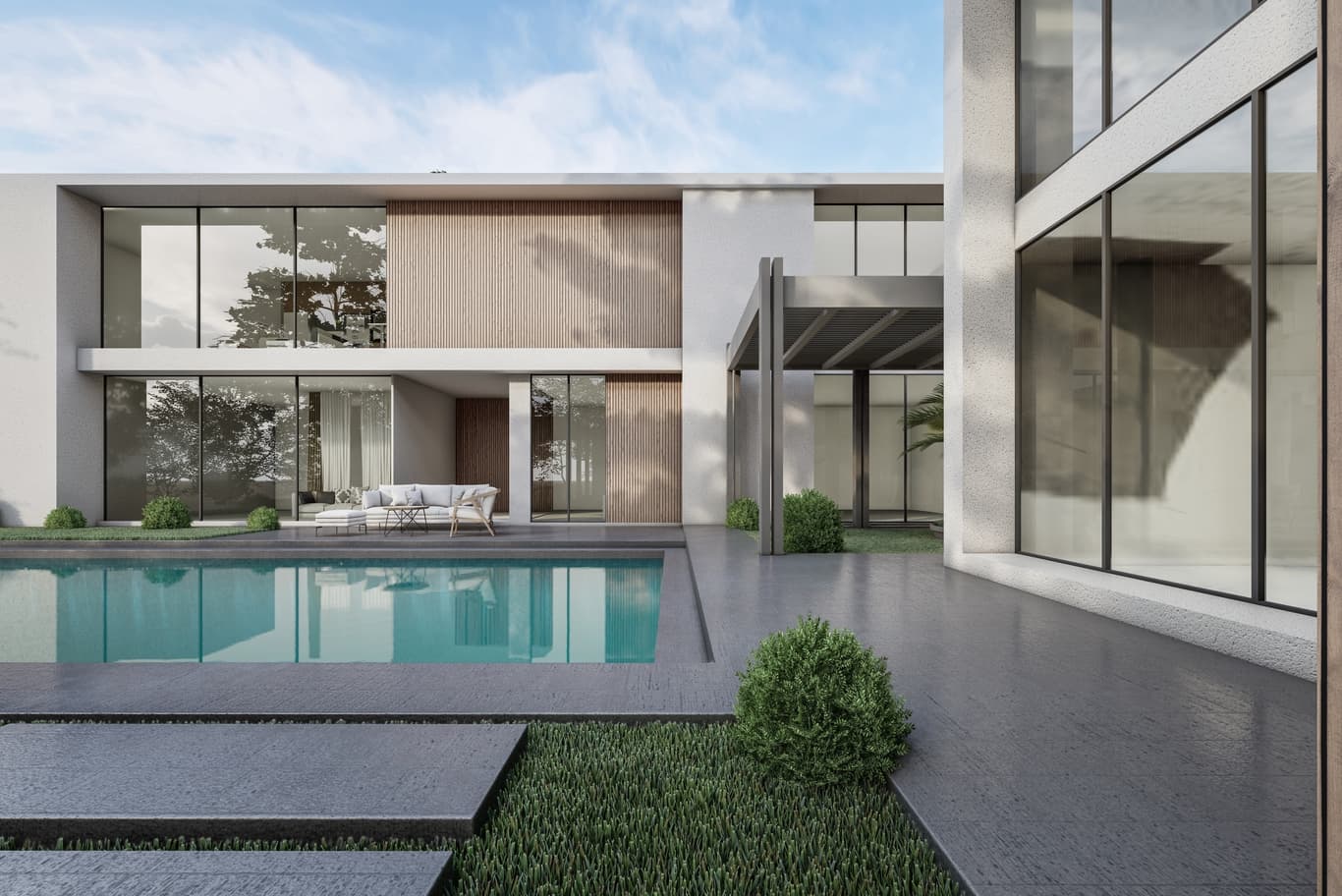
Pool construction for Dubai villas covers structural design, permits, and site sequencing. Here is how the process works on site.
A swimming pool is one of the most technically demanding elements on any villa construction programme. It involves structural engineering, waterproofing, mechanical and electrical systems, tile or stone finishes, and coordination with the surrounding hardscape and landscape works — all within a site area that is usually constrained by setback requirements and underground service routes. On paper, a pool looks like a hole in the ground with water in it. On a construction programme, it is a concrete shell that needs to be poured at exactly the right point in the build sequence, with a plant room that was planned into the layout months earlier, and a permit package that was submitted before ground was broken.
We build pools as part of villa construction and landscape projects across Dubai. This guide covers the design decisions, the permit process, the cost structure, and the construction sequencing based on what we manage on site — not what pool showroom brochures promise.
Pool Design Decisions That Affect the Build
The design of a villa pool is not just an aesthetic choice. The pool type, size, depth profile, edge detail, and finish material each have direct implications on the structural design, the MEP specification, the permit submission, and the construction cost.
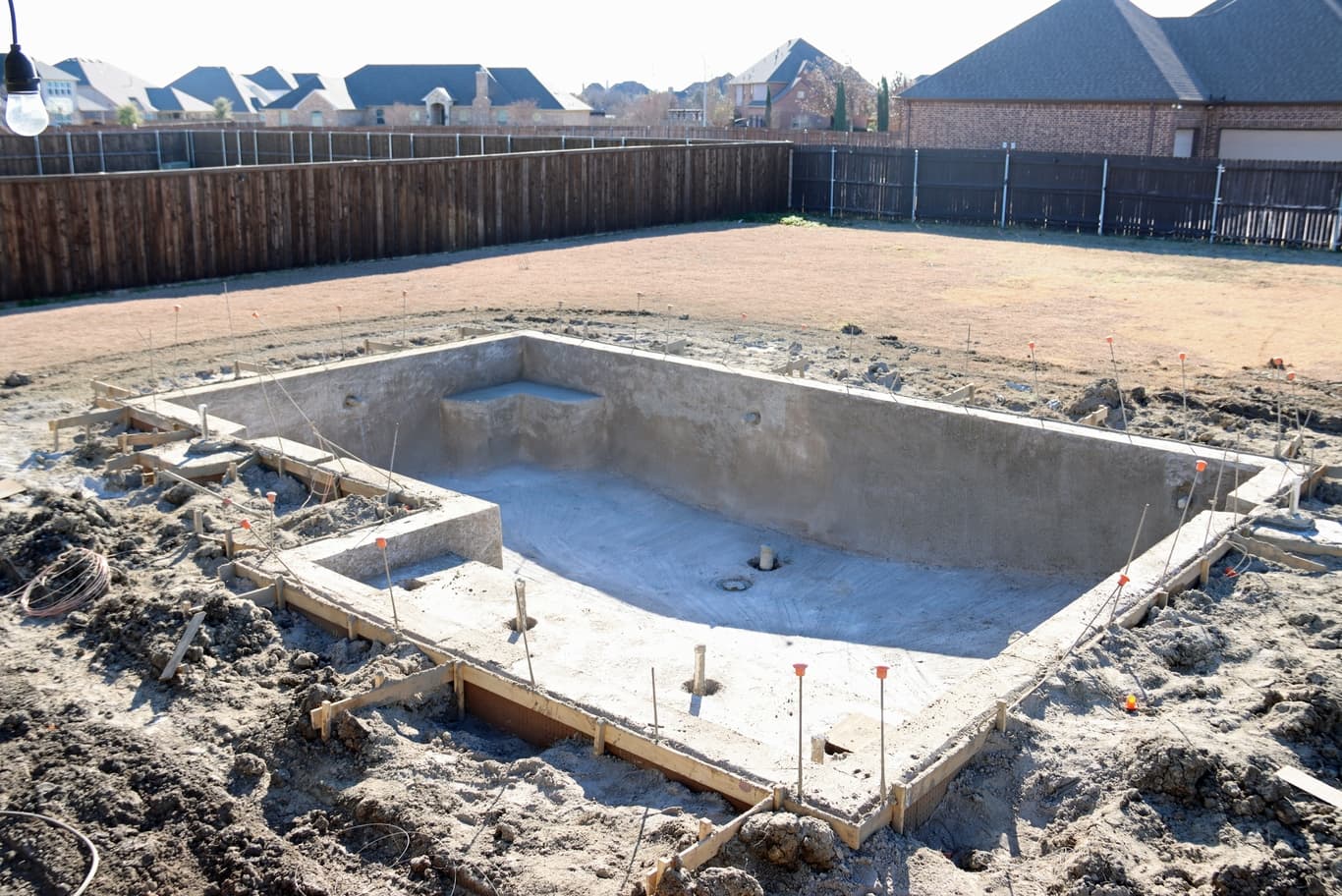
Pool type and structure. Residential pools in Dubai are built as reinforced concrete shells — either poured in-situ with formwork or constructed using shotcrete (sprayed concrete) depending on the geometry. Fibreglass shells, common in other markets, are rarely used on villa projects here because the sizes and shapes clients want exceed standard fibreglass moulds, and the finish quality does not match the expectations on a high-end build. A rectangular pool with a constant depth is the simplest to engineer and form. Freeform shapes, variable depth profiles, integrated spas, and vanishing-edge details all add structural complexity, reinforcement requirements, and waterproofing risk.
Edge detail. This decision carries more consequences than most homeowners expect. A standard bullnose coping is straightforward to build and tile. A perimeter overflow (wet edge) pool requires a balance tank, a surge pit, and a return system that recirculates the overflow water — adding both cost and plant room space. An infinity edge on one or more sides needs a catch trough, structural support for the cantilevered slab, and careful levelling to within a few millimetres across the full edge length. The edge detail affects the pool's structural design, the hydraulic calculations, the plant room sizing, and the surrounding hardscape levels. It needs to be confirmed at the concept stage, not changed during construction.
Depth profile and safety compliance. Dubai Municipality's Technical Guidelines for Approval of Swimming Pool Plans (DM-HSD-GU34) set specific requirements that directly shape the pool's depth profile and access provisions. Stairs and ladders are mandatory when the pool depth exceeds 600mm. At least one ladder is required for every 30 metres of pool circumference, and ladders must be corrosion-resistant with anti-slip stepping surfaces. If the depth exceeds 1.4 metres, the guidelines prohibit internal stairs and require side-mounted ladders that extend above the pool's edge. These are not optional recommendations — they are conditions of plan approval. If your pool design does not comply, the submission is returned for correction, and that adds weeks to your permit timeline.
Finishes. Glass mosaic tile is the most common finish on Dubai villa pools because it handles the UV exposure, the chemical environment, and the thermal cycling better than most alternatives. Natural stone pool interiors are used on some high-end projects but require specific adhesive systems and more careful chemical management to prevent etching. The finish choice also drives the background preparation — mosaic tile needs a smooth render substrate, while some stone finishes tolerate a rougher base.
Pool surrounds. Dubai Municipality requires that swimming pools be surrounded by a continuous unobstructed deck or walkway not less than 1.2 metres wide, constructed in impervious material with a smooth, non-slip, easily cleanable surface. All decks must maintain a 2% slope to drain water effectively to deck drains. These specifications need to be incorporated into the hardscape design from the start — they affect the terrace layout, the levels around the pool, and the material choices for the coping and surrounding paving.
For homeowners still developing their concept who want to see how pool design integrates with broader villa planning, we documented a range of approaches across completed villa builds in Dubai that include outdoor living and pool configurations at different scales.
The Permit and Regulatory Process for Pool Construction
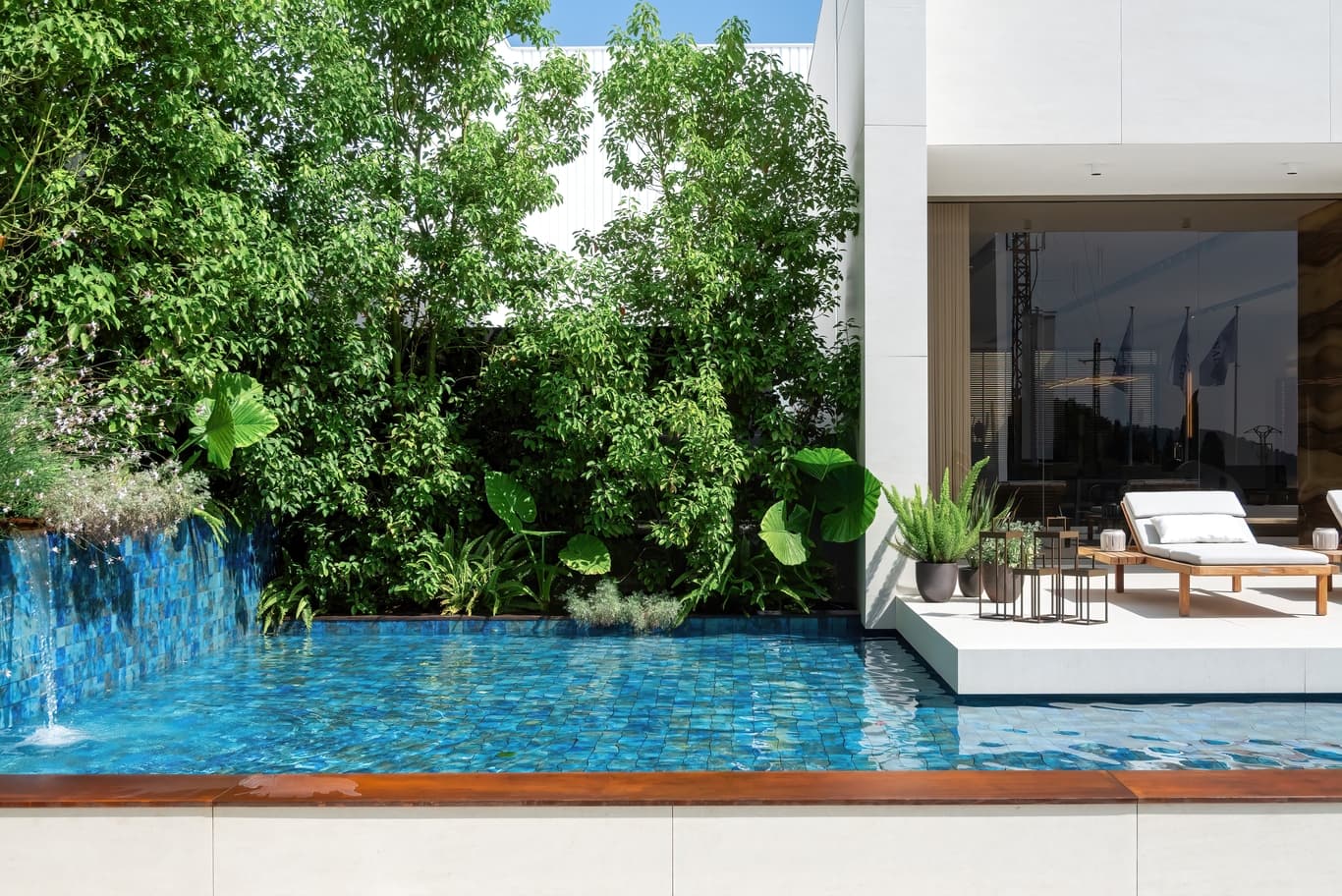
Pool construction in Dubai requires permits from Dubai Municipality, and for villas in master-planned communities, additional approvals from the developer's community management team. The regulatory framework is governed primarily by Local Order No. 61/1991 and Local Order No. 11/2003, which set the planning, building, maintenance, and safety regulations for swimming pools in the emirate. Understanding this process — and starting it early — is what prevents permit delays from stalling the construction programme.
Dubai Municipality submission. Pool plan approvals are managed through the Health and Safety Department of Dubai Municipality. For areas under DM jurisdiction, the application is submitted through the Dubai Building Permits System (Dubai BPS), the unified online platform for building permit services. The submission package must include structural engineering drawings showing the shell design, reinforcement details, and waterproofing specification. It also requires a full set of pool-specific documents: pool cross-sections demonstrating the base slope with all dimensions, pipe fitting layouts for the pool and pump room, electrical diagrams, schematic diagrams of the water circulation and filtration system, pump room layout with sterilisation and disinfection system details, and water turnover calculations. Drawings must be submitted electronically in multi-sheet DWF format and include the project front page with the owner's signature.
The pool category and type must be clearly indicated on the submission, and permit fees are payable as determined by Dubai Municipality's Revenue Department. The review-and-approval cycle typically takes four to six weeks, though submissions with drawing errors, missing documents, or non-compliant designs are returned for correction, which can add another two to four weeks per resubmission. We covered the broader regulatory framework for construction permits in Dubai in a separate guide — the pool-specific requirements sit within that larger system.
Additional NOCs. Beyond the DM pool plan approval, a residential pool project in Dubai requires clearances from several other authorities. DEWA (Dubai Electricity and Water Authority) must approve the electrical and plumbing connections. Dubai Civil Defence reviews fire safety provisions where the pool plant room houses gas-fired heating equipment or where the pool is located near the villa's fire escape routes. The Dubai Municipality building permit procedures page outlines the broader coordination requirements between these entities for construction projects.
Community-level approvals. In master-planned communities like Dubai Hills, Tilal Al Ghaf, Arabian Ranches, and Emirates Hills, the developer's community management authority has its own approval layer. Community guidelines may restrict pool placement relative to boundary walls, height of surrounding enclosures, lighting spill to neighbouring plots, noise levels from plant equipment, and materials visible from adjacent properties. These community submissions need to happen early — ideally in parallel with the DM submission — because community approval often takes longer than the municipality permit and cannot be bypassed.
Modification restrictions. DM guidelines are explicit on this point: it is prohibited to change the design of a swimming pool, add a diving board, install slides, or add a bridge crossing the pool after approval without referring back to the Health and Safety Department and submitting revised detailed plans. This means the design needs to be finalised before submission, not treated as a work-in-progress that will be adjusted during construction.
Construction Sequencing and Site Coordination
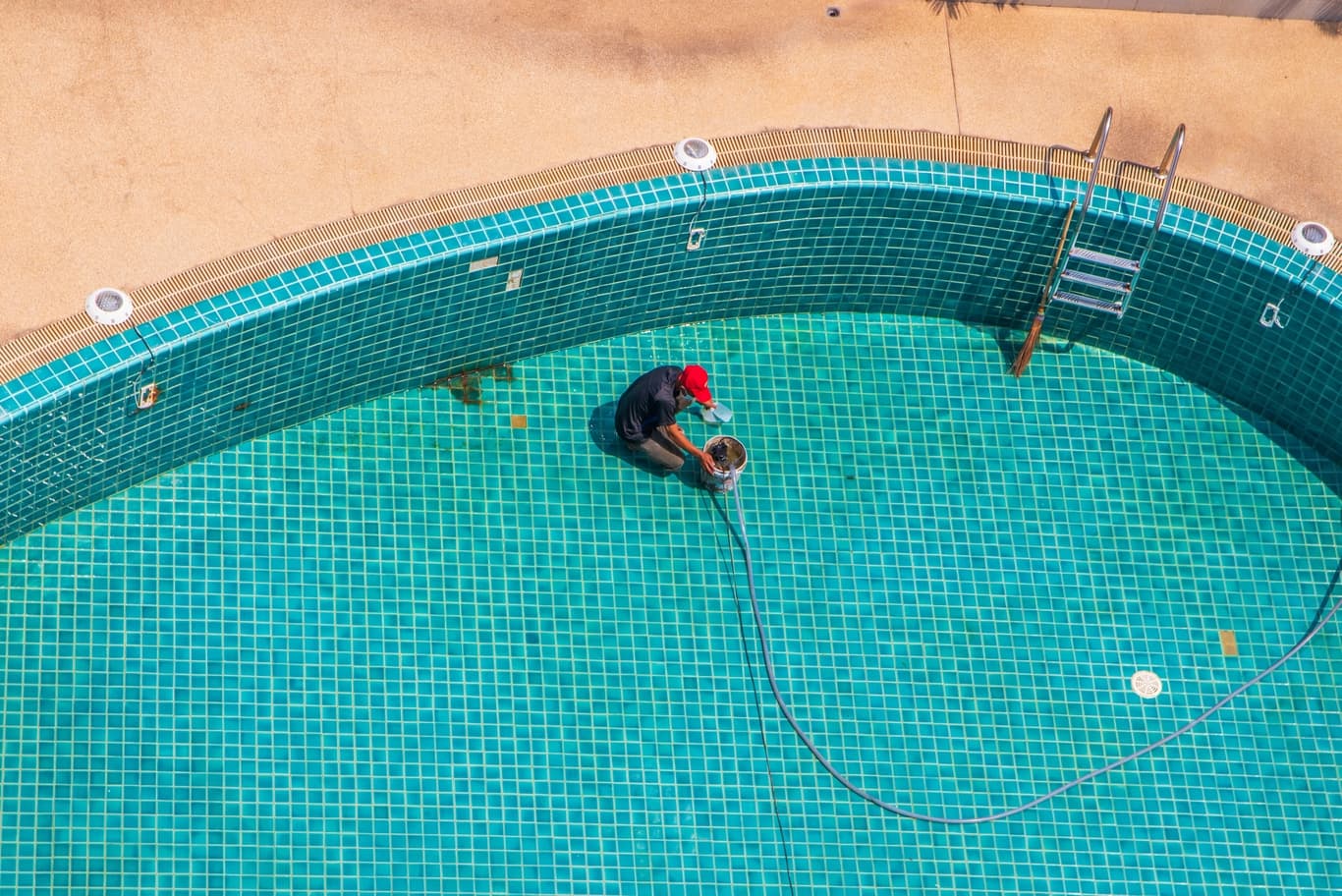
Pool construction has a fixed position in the build programme, and getting the sequencing wrong is expensive.
The pool shell needs to be built while the site is still open for heavy equipment access — excavators for digging, concrete pumps for pouring, and crane trucks for lifting rebar cages and precast elements if applicable. On a villa project where the pool sits within the rear garden area, this means building the pool shell early in the programme, ideally during or immediately after the villa's substructure and ground floor slab works. If the pool is left until the landscape phase, the heavy equipment needed for excavation and concrete placement has to cross finished driveways, paved terraces, or planted areas — causing damage that costs money to repair.
On our Tilal Al Ghaf outdoor living project — an 8,500 sq ft landscape construction scope that included a reinforced concrete pool with mosaic tile finish and perimeter overflow — we built the pool shell early in the programme while ground access was still open. The pool's below-grade plant room housing filtration, heating, and chemical dosing equipment was constructed at the same time as the pool shell, with all service connections trenched and stubbed up during the initial groundworks. By the time the hardscaping and planting crews arrived, the pool structure was complete and the surrounding terrace paving tied into the pool's finished levels without any rework. The outdoor kitchen, pergola, and irrigation infrastructure were all sequenced around the pool as the anchor point of the outdoor programme.
That sequencing approach is standard across our villa builds. Our project delivery team programmes pool construction as an early-phase deliverable on every project where outdoor works are in scope. The alternative — building the pool late and working around completed finishes — adds cost, adds programme time, and risks damage to work that is already done.
Plant room planning. The filtration system, circulation pumps, heating unit, and chemical dosing equipment need a dedicated space with power, drainage, ventilation, and access for maintenance. On a villa build, this is typically a below-grade chamber adjacent to the pool or a utility room within the villa's service areas. Dubai Municipality requires the pump room layout, sterilisation systems, and water turnover calculations to be documented in the permit submission, so the plant room design is not something that can be deferred — it is a permit requirement.
The plant room's location affects structural layout, MEP routing, and the pipe runs between the pool shell and the equipment. A plant room positioned as an afterthought ends up with pipe runs longer than necessary, which increases head loss and pump energy consumption. On the Tilal Al Ghaf project, the below-grade plant room was built concurrently with the pool shell, and all pipework was trenched during the same groundworks phase — one mobilisation, one excavation, no rework.
For a detailed breakdown of how outdoor and pool works fit within the stages of a villa build from concept through handover, that guide covers the full construction sequence and where pool works sit within it.
Pool Construction Costs for Dubai Villas
Pool construction costs depend on size, depth, edge detail, finish material, and the complexity of the plant room and hydraulic system. The ranges below reflect what we are pricing and delivering on current villa projects.
A standard rectangular pool of 30 to 50 sqm with a constant depth, bullnose coping, glass mosaic tile finish, and a basic filtration and circulation system typically costs between AED 180,000 and AED 350,000. That includes the structural shell, waterproofing, tile finish, coping, plant room equipment, piping, and commissioning.
A larger pool of 50 to 80 sqm with a variable depth profile, perimeter overflow or infinity edge, integrated spa or water features, and a premium tile or stone finish moves the range to AED 400,000 to AED 750,000. The overflow system alone — balance tank, surge chamber, and return pumps — adds AED 80,000 to AED 150,000 over a standard skimmer-type pool of the same size.
Heating is a separate line item. A heat pump system for a mid-size villa pool in Dubai runs AED 25,000 to AED 50,000 depending on the unit capacity. Solar thermal heating is an alternative with lower operating costs but higher upfront investment and roof space requirements.
Permit fees are payable to Dubai Municipality's Revenue Department as part of the approval process. While the pool permit fee itself is relatively modest, the cost of preparing the submission package — structural engineering drawings, MEP documentation, and consultant coordination — needs to be budgeted as part of the design and pre-construction phase.
These numbers do not include the surrounding hardscape (terrace paving, coping surrounds, deck areas), landscaping, outdoor lighting, or fencing and enclosures. On the Tilal Al Ghaf project, the pool was one component of an 8,500 sq ft outdoor construction scope that also included natural stone paving, an outdoor kitchen, a pergola, boundary walls, softscaping, irrigation, and lighting — each priced as a separate trade package within the overall villa contracting programme.
Ongoing Maintenance Considerations That Start at the Design Phase
A pool's long-term maintenance cost and complexity are determined by decisions made during design, not after the pool is filled. DM regulations require that swimming pool water is filtered and disinfected to specified parameters, with the total water volume recirculated at frequencies determined by pool type and usage. Designing the filtration and chemical dosing systems to meet these requirements from the start avoids costly retrofits later.
Chemical dosing. Systems range from manual test-and-dose (lowest upfront cost, highest ongoing effort) to fully automated controllers that monitor pH, ORP, and chlorine levels and dispense chemicals through peristaltic pumps. Automated systems cost AED 15,000 to AED 30,000 more upfront but reduce the homeowner's involvement and keep water chemistry more consistent, which extends the life of tile finishes and grout.
Filtration media. Sand filters are the standard and most cost-effective option. Glass media filters offer finer filtration and longer media life at a modest premium. Diatomaceous earth filters provide the finest filtration but require more maintenance and media replacement. The choice depends on the pool's usage pattern, the finish material, and the homeowner's tolerance for maintenance involvement.
Plant room access. Pumps, filters, and heaters need periodic maintenance and eventual replacement. A plant room with a 600mm access hatch and equipment packed against three walls makes every service call slower and more expensive. We specify minimum clearances around all equipment and access panels large enough to remove and replace the largest component — typically the filter vessel — without demolishing any surrounding structure.
Remote monitoring. Connected controllers, leak detection sensors, and automated chemical dosing increasingly tie into the same smart home infrastructure that villa builds should plan for during construction. We discussed how drone and AI-based monitoring tools are reshaping construction site operations — the same sensor and automation principles apply to pool plant operations once the villa is occupied, allowing remote visibility of water quality, equipment status, and energy consumption.
Landscape integration. For villas where the pool is part of a broader outdoor living design including gardens, terraces, and entertainment areas, the landscape planning needs to account for pool equipment access, chemical storage locations, drainage outfalls, and the visual screening of plant rooms and service areas. We covered planning strategies for compact outdoor spaces that address how to balance functional requirements — including pool infrastructure — with the overall design intent.
Start Your Pool Project During the Design Phase
If you are planning a villa build or landscape renovation and a pool is on the brief, the design and permit work needs to start during the project's early design stages — not after the villa is handed over and the garden is an empty plot. Capital Associated builds pools as part of the villa construction and landscape programme, handling the structural, MEP, and finishing works in coordination with every other trade on site so the pool is delivered on programme and on budget.
Frequently Asked Questions
Do I need a permit to build a swimming pool in my Dubai villa?
Yes. Dubai Municipality requires a permit for residential pool construction under Local Order No. 61/1991 and No. 11/2003. The submission is processed through the Health and Safety Department and requires structural drawings, MEP documentation including filtration and circulation system details, and a site plan. In master-planned communities, you also need separate approval from the developer's community management authority.
How long does villa pool construction take in Dubai?
From excavation to commissioning, a standard residential pool takes eight to twelve weeks. That does not include the design and permit phase, which typically adds six to ten weeks before construction starts. Perimeter overflow and infinity edge pools take longer due to the additional balance tank construction and hydraulic commissioning. The total timeline from first design meeting to filled pool is usually four to six months.
Is it cheaper to build the pool during villa construction or add it later?
Building the pool during the villa construction programme is significantly cheaper. The site is already open, heavy equipment is mobilised, and service connections can be trenched alongside the villa's own groundworks. Adding a pool after the villa is complete and landscaping is finished means re-excavating, working around completed surfaces, and potentially damaging hardscape and planting that was already installed.
What are Dubai Municipality's key safety requirements for residential pools?
The DM technical guidelines require ladders or steps when pool depth exceeds 600mm, at least one ladder per 30 metres of pool circumference, corrosion-resistant ladders with anti-slip surfaces, a minimum 1.2-metre-wide continuous deck around the pool with a 2% drainage slope, and adequate underwater and overhead lighting. Modifications to an approved pool design — including adding diving boards, slides, or bridges — are prohibited without resubmitting revised plans to the Health and Safety Department.
How much does a villa swimming pool cost in Dubai?
A standard 30 to 50 sqm pool with mosaic tile finish, bullnose coping, and a basic filtration system costs between AED 180,000 and AED 350,000. Larger pools with overflow edges, integrated spas, or premium finishes range from AED 400,000 to AED 750,000. These figures cover the shell, waterproofing, finishes, plant room equipment, and commissioning but exclude surrounding hardscape and landscaping.
What ongoing maintenance does a villa pool in Dubai require?
Weekly chemical testing and dosing (or an automated system), regular filter backwashing or media replacement, pump and heater servicing, and periodic tile and grout inspection. Dubai's high temperatures and UV exposure increase chemical consumption compared to cooler climates. Dubai Municipality requires pool water to be filtered and disinfected to specified parameters, so maintenance is both a practical and regulatory requirement.